| Model: | T550D |
|---|---|
| Function: | It enables the deposition of high-quality gold films, silver films, and low-melting-point compound films such as MgF2, WO3 and ZnS at room temperature. |
| Engineer: | Fu / +86-21- 34206126-6010 / xuecheng.f@1 |
| Location: | East Area – Thin Film IV |
| Equipment ID: | EFM3RHE01 |

Adopting electric heating to melt the materials to be evaporated, the system enables the deposition of high-quality gold films, silver films, and low-melting-point compound films such as MgF2、WO3、ZnS, and on substrates at room temperature.
Process/Testing Capability
1. The equipment supports the processing of samples with a size below 8 inches;
2. The thickness of evaporated thin films shall not exceed 500 nm;
3. The non-uniformity of deposited samples is within ±5% for 8-inch samples (excluding aluminum).
Technical Specifications
1. The non-uniformity of deposited aluminum samples is within ±7% for 8-inch substrates;
2. The non-uniformity of deposited gold and silver films is within ±3% for 8-inch substrates.
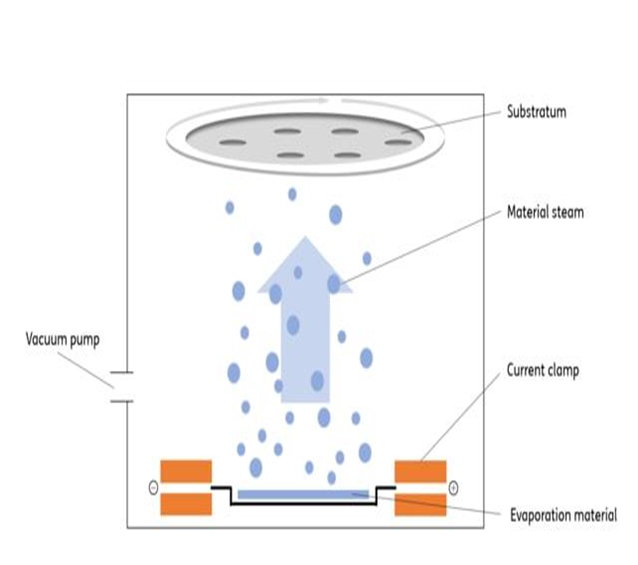
With resistive heating, high melting point metals (such as tungsten, molybdenum, tantalum, etc.) are fabricated into evaporation sources. The Joule heat generated by high current passing through the evaporation source is used to directly heat and evaporate the coating materials, or to realize indirect heating and evaporation in crucibles, so that the materials can deposit and form thin films on the substrate surface.

The 100 nm gold film deposited by the resistive heating evaporation equipment eliminates discharge spattering and delivers superior film quality.
2.A maximum of two types of thin films can be deposited in a single batch.
2.Its effective power is lower than that of electron beam evaporation, making it more difficult to evaporate high melting point materials.

Address: 800 Dongchuan Road, Minhang District, Shanghai 200240, China
Tel: +86 21 3420 7734
Email: aemd@sjtu.edu.cn