| Model: | TFS200 |
|---|---|
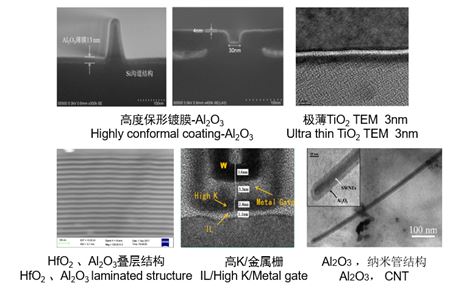
| Function: | It is equipped with two operating modes, thermal ALD and PE-ALD. Thin film deposition can be realized by heating or plasma assistance to prepare a variety of ultra-thin dielectric films with high conformality and excellent step coverage, such as metal oxides. The film thickness can be precisely controlled at the atomic layer level (1 atom-layer per cycle). Depositable films include aluminum oxide Al2O3, aluminum nitride AlN, silicon dioxide SiO2, hafnium oxide HfO2, hafnium nitride Hf3N4, titanium dioxide TiO2, tantalum pentoxide Ta2O5 and tantalum nitride TaNx. |
| Engineer: | Wu / +86-21- 34206126-6028 / lynn_wu@1 |
| Location: | West Area – Thin Film IA |
| Equipment ID: | WF1BALD01 |

It supports two operating modes: thermal ALD and PE-ALD. With heating or plasma assistance, a variety of ultra-thin dielectric films with high conformality and superior step coverage (such as metal oxides) can be deposited, and the film thickness can be precisely controlled at the atomic layer level (1 atom-layer/cycle).
Process/Testing Capability
Depositable thin films include: aluminum oxide Al2O3, aluminum nitride AlN, silicon dioxide SiO2, hafnium oxide HfO2, hafnium nitride Hf3N4, titanium dioxide TiO2, tantalum pentoxide Ta2O5, tantalum nitride TaNx, phosphorus oxide POx, and customized ferroelectric HfZrO thin films.
Technical Specifications
1.Sample size: 8-inch and downward compatible;
2.Coating uniformity: The uniformity on 8-inch substrates is better than ±1% for thermal processes and ±2% for plasma-enhanced processes;
3. Process temperature and temperature control accuracy: Room temperature ~ 350 °C; deposition temperature control accuracy: ±1 °C; reaction chamber temperature control accuracy: ±2 °C.
In addition, plasma treatment effectively removes impurities inside the films, achieving lower resistivity and higher film density. Meanwhile, plasma can also be applied to reaction chamber cleaning and substrate surface activation.
Samples shall be smaller than 8 inches and kept clean. Powder samples and contaminated samples (e.g., volatile organic compounds, photoresist, etc.) are not acceptable. Please communicate and confirm with engineers before making a reservation.
【PEALD Charging Regulations】
①For depositing a single material, the charge shall be calculated in accordance with the standard hourly rate of the AEMD platform. The timing starts from sample loading into the equipment and ends when the process is completed and the samples are unloaded.
②Deposition of different material systems (doping processes) involves increased process complexity:
a) For doping types equal to 2, mature standard processes are charged at the regular hourly rate. Material fees are calculated based on the dominant component. The timing rule is consistent with Clause 1.b) For doping types more than 2, the process difficulty and equipment risk increase significantly. Such reservations are not accepted in principle. If deposition is required for research purposes and complete process parameters are provided, regular fees specified in Item a shall be charged additionally with extra labor costs.
③Deposition of different material systems (multilayer film processes) involves complex operations. Before depositing the next layer, the previous process recipe must be terminated, the manual valve of the corresponding precursor closed, and the pipeline purged. The process recipe for the new layer shall be imported and operated with its manual valve opened, and so on. Each material switching is regarded as an independent process, and a separate reservation is required in principle:
a) For a total of 2 deposition layers: the first layer is charged normally. If the thickness of the second layer is ≤ 5 nm, labor and equipment fees will be waived considering no sample transfer, with only material fees charged.
b) For a total of 2 deposition layers: if the thickness of the second layer is greater than 5 nm, an independent reservation and separate settlement are required, charged at the standard hourly rate.
c) For more than 2 deposition layers, each layer requires an individual reservation and separate settlement at the standard hourly rate.
④Limited precursor source positions are available on the equipment. For non-platform conventional material systems with high reservation demands, risk assessment and official approval by platform management are mandatory. All source bottles, VCR gaskets and precursor materials shall be purchased by the user.
⑤ For long-term mature standard processes, refunds are applicable only if valid failure evidence is provided and mutually recognized by both parties. Non-standard processes are classified as research and development activities, and the platform shall not be liable for process failures.
⑥ The minimum billing unit for process duration is 30 minutes. Any duration less than 30 minutes will be counted as 30 minutes for charging.

Address: 800 Dongchuan Road, Minhang District, Shanghai 200240, China
Tel: +86 21 3420 7734
Email: aemd@sjtu.edu.cn