| Model: | PDS-2010 |
|---|---|
| Function: | Deposition of Parylene C, D, N, and F materials. |
| Engineer: | Fu / +86-21- 34206126-6010 / xuecheng.f@1 |
| Location: | East Area – Thin Film IV |
| Equipment ID: | EW1PDSS01 |

This system is used for the deposition of poly-para-xylylene (Parylene) thin films, including types C, D, N, and F. The achievable film thickness ranges from 500 nm to 50 μm.
Process / Testing Capabilities
Technical Specifications
Parylene N: Low dissipation factor, suitable for high-frequency RF applications (dielectric loss ~0.0006 at 1 MHz)
Parylene C: Contains a chlorine atom on the benzene ring, resulting in extremely low permeability to moisture and corrosive gases (resistivity: 6–8 × 10¹⁶ Ω·cm at 25°C, 50% RH)
Parylene F: Suitable for high-temperature and UV-resistant applications
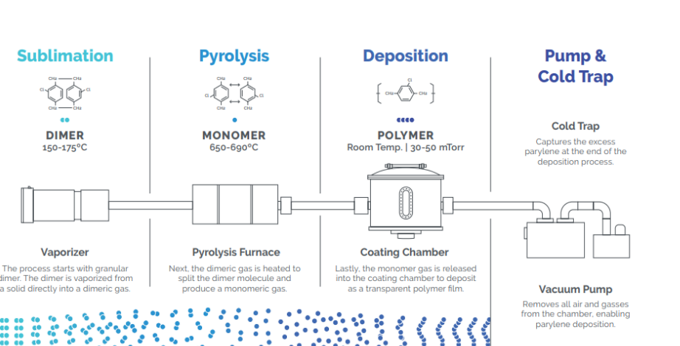
Pyrolysis: The gaseous dimer enters a pyrolysis chamber (~680°C), where it is cracked into reactive monomers
Deposition: The monomers enter a room-temperature vacuum deposition chamber and polymerize on the substrate surface, forming a uniform, dense, and pinhole-free thin film

Address: 800 Dongchuan Road, Minhang District, Shanghai 200240, China
Tel: +86 21 3420 7734
Email: aemd@sjtu.edu.cn