| Model: | uMLA |
|---|---|
| Function: | Photoresist direct writing function, which directly writes micron-scale photoresist patterns on the substrate; overlay direct writing function; SU8 photoresist direct writing function |
| Engineer: | Wang / +86-21-34206126-6005 / fdwang@1 |
| Location: | East Area – Lithography IIIA |
| Equipment ID: | ELT3MLA01 |

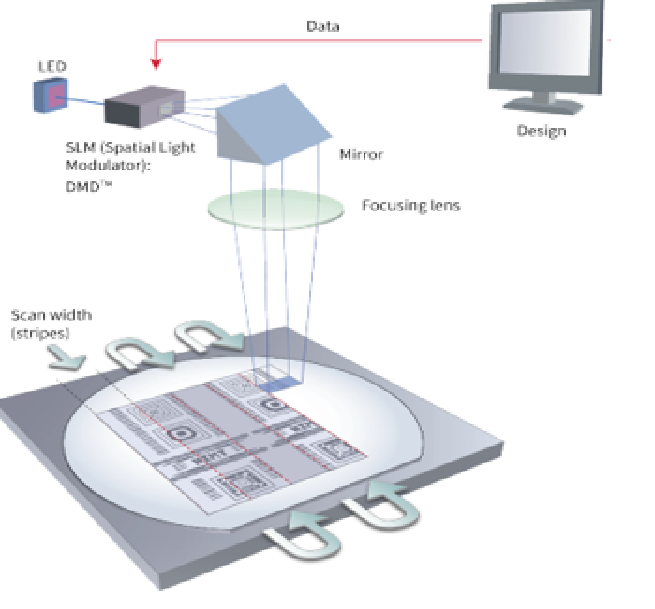
As a maskless lithography technique, laser direct-write lithography uses a laser beam with variable intensity to perform variable-dose exposure on the photoresist material on the surface of a substrate. After development, the required patterns are formed on the surface of the photoresist layer. It enables high-precision processing without the need for fabricating masks and is applicable to the processing of various materials, including glass, metals, silicon wafers, semiconductors, polymers, and others.
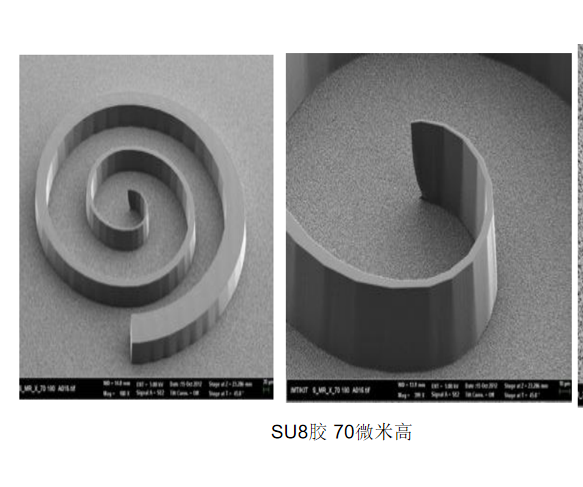
It can be applied to the processing of a variety of different materials, including glass, metals, silicon wafers, semiconductors, polymers, etc., and is widely used in fields such as microelectronics, biomedicine, optics and nanodevices. It can be used for the preparation of microprocessors, sensors, microstructures, biochips, microfluidic chips, MEMS, SU8 photoresist direct-write processing, etc.
1. The maximum sample size shall not exceed five inches.
2. The minimum sample size is 1.5cm*1.5cm. Samples that are too small will cause difficulty in automatic focusing and are prone to colliding with the writing head during patterning!
3. Ensure that the exposed pattern is at least 0.5cm away from the edge of the sample.
4. Special attention for circular samples: Ensure that each patterning position is at least 0.5cm away from the nearest edge of the sample.
5. For exposed pattern arrays: Be sure to ensure that the periphery of the array is at least 0.5cm away from the edge of the sample.
1. The maximum sample size shall not exceed five inches.
2. The minimum sample size is 1.5cm*1.5cm. Samples that are too small will cause difficulty in automatic focusing and are prone to colliding with the writing head during patterning!
3. Ensure that the exposed pattern is at least 0.5cm away from the edge of the sample.
4. Special attention for circular samples: Ensure that each patterning position is at least 0.5cm away from the nearest edge of the sample.
5. For exposed pattern arrays: Be sure to ensure that the periphery of the array is at least 0.5cm away from the edge of the sample.
6. Machine operation qualification certification is required for independent operation.
Please close the software and restart it.

Address: 800 Dongchuan Road, Minhang District, Shanghai 200240, China
Tel: +86 21 3420 7734
Email: aemd@sjtu.edu.cn